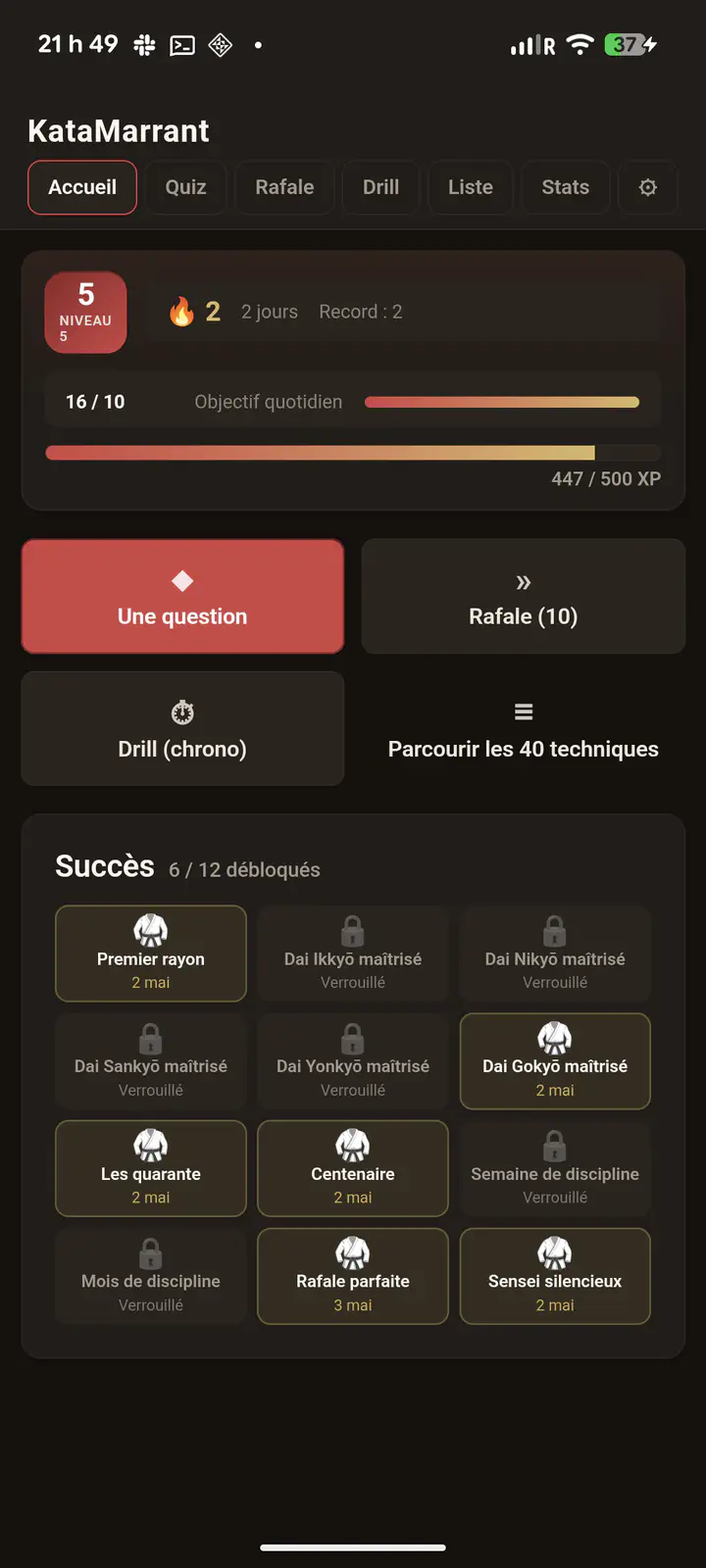
KataMarrant is a small judo training app I build on the side. The goal is narrow and concrete: drill the 40 Gokyo no Waza, the classical Kodokan set of throws every judoka is expected to know by name, in short daily sessions. The app runs on Windows, macOS, Linux, Android, and iOS from a single Tauri 2 codebase, with vanilla JS on the frontend and Rust on the backend.
There are four practice modes. One question is the lowest-friction button on the home screen, for the moments when I have less than thirty seconds. Rafale is a ten-question burst, the warm-up I do on the metro. Drill (chrono) is a timed mode with a per-question countdown, including an audio variant where the technique name is read aloud and you pick the matching description. Browse the 40 techniques is the reference catalogue, grouped by kyo, with romaji, kanji, the French translation, and a curated demo video for each throw.
The quiz logic borrows the basics from spaced repetition: techniques you miss surface more often, a six-question cooldown prevents back-to-back repeats, and per-technique mastery scores follow you across devices when sync is enabled. Sync is opt-in, magic-link only, with no passwords stored anywhere. A daily goal, a streak counter, an XP curve, and a small grid of unlockable achievements sit on the home screen, borrowing from a decade of language-learning and fitness apps.
The technique illustrations are extracted from the Gokyo no Waza plate on Wikimedia Commons by user Mtwist (CC BY-SA). The reference videos are curated by judo.how. The project is open source, not affiliated with the Kodokan or any judo federation, and is documented on this site in a series of build posts.

Antoine Weill--Duflos
Head of Technology and Applications
My research interests include haptic, mechatronics, micro-robotic and hci.