A Pocket Rolling Stone, Part 4: All of This to Make a Moo Box
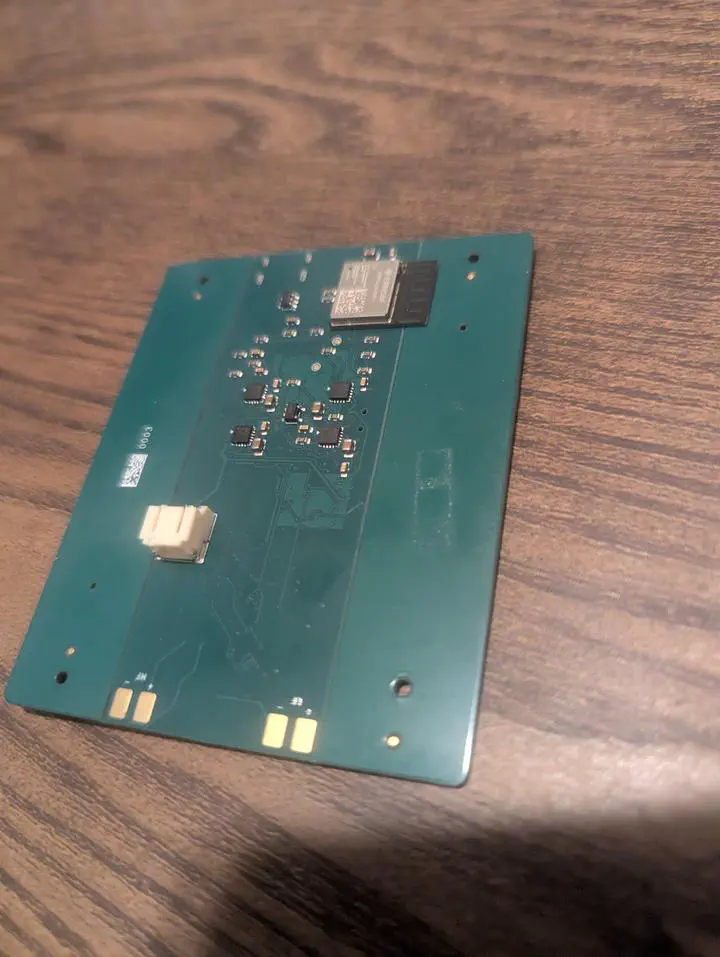 The A7 board from the PCB build. A surprisingly elaborate route to a moo box.
A custom circuit board. Four actuator channels. An inertial sensor, a physics simulation, audio synthesis, filters and output limiters.
All of this to make a moo box.
You know the toy: turn it over, and it goes mooooo. The familiar toy moos in one direction; my virtual version takes the liberty of mooing both ways. After all the work on the virtual rolling stone, this feels like a perfectly reasonable destination. Perhaps not the most direct route to a moo, but certainly an interesting one.
View the short silent GIF loop.
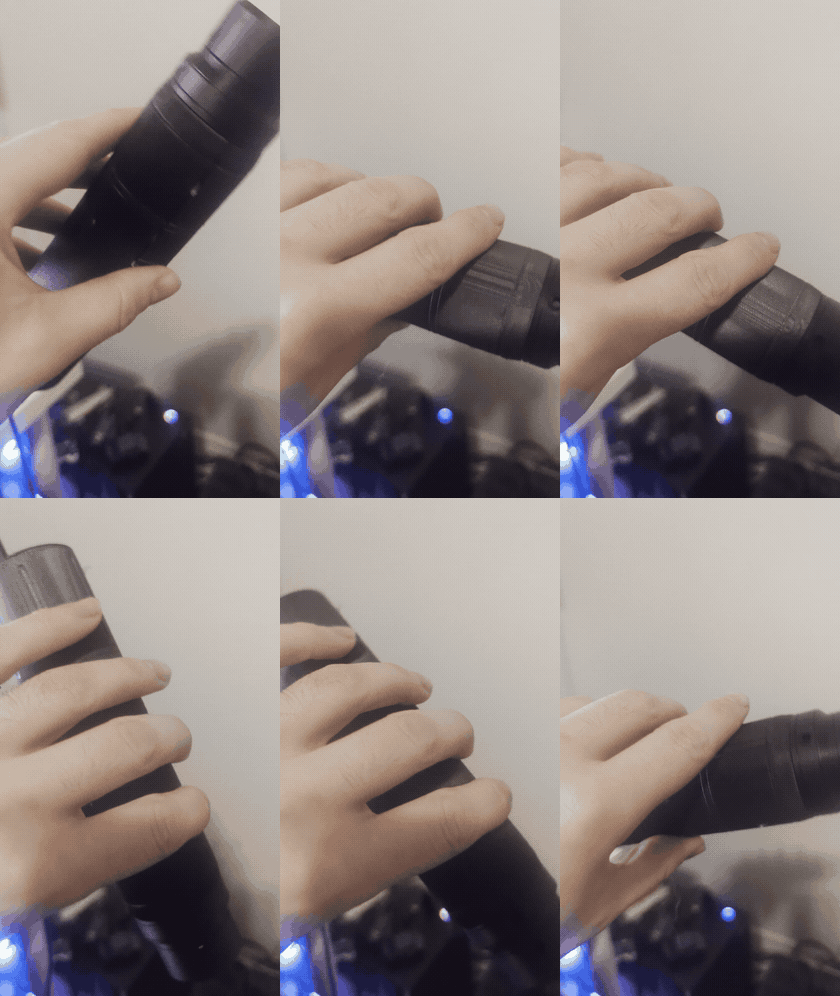
In Part 3, the custom boards arrived. Since then, the firmware has become a collection of imaginary objects sharing one handle: a rolling ball, a textured slide, a box of marbles, a lightsaber, a rainstick, and now that cow. The interesting part is how differently these objects use the same outputs.
First, build an imaginary moo box
The moo is synthesized, not played from a cow recording. The firmware models a piston travelling along a tube. Tilt the handle far enough, about 15 degrees, and gravity starts it moving. Its motion produces a virtual airflow, which drives a reed-like sound through two changing vocal resonances.
As the piston gathers speed, the sound grows and its pitch rises. The resonances move with the airflow to give the voice a changing mouth shape: from a closed mm, through a brighter opening, toward oo. A little breath noise and pitch wobble keep it from being a perfectly steady electronic tone.
At the end of the tube, the piston lands. The airflow drops and a separate contact sound supplies the clunk. Reverse the tilt and the piston can travel back: another moo, in the other direction.
That is the appeal of this particular detour. The sound has a cause inside the model. The gesture controls an imaginary mechanism rather than simply pressing an invisible play button.
One signal, four actuators
The fun starts when the same sound takes different routes to the hand. A low band gives the effect body, the middle carries roughly 120 Hz to 1.2 kHz, and the high band brings out detail. LFi adds a different ingredient: negative-side bass between events, with positive pulses for impacts.
The figure below starts with one simple signal containing three tones. On the left are the firmware’s filter responses; on the right is what each route does to that same signal. Follow the orange row: the bass is filtered first, then only its negative side is retained. That asymmetric operation is why LFi cannot be described by a frequency curve alone.
Open the filter figure at full size. On a phone, tap to enlarge and zoom.
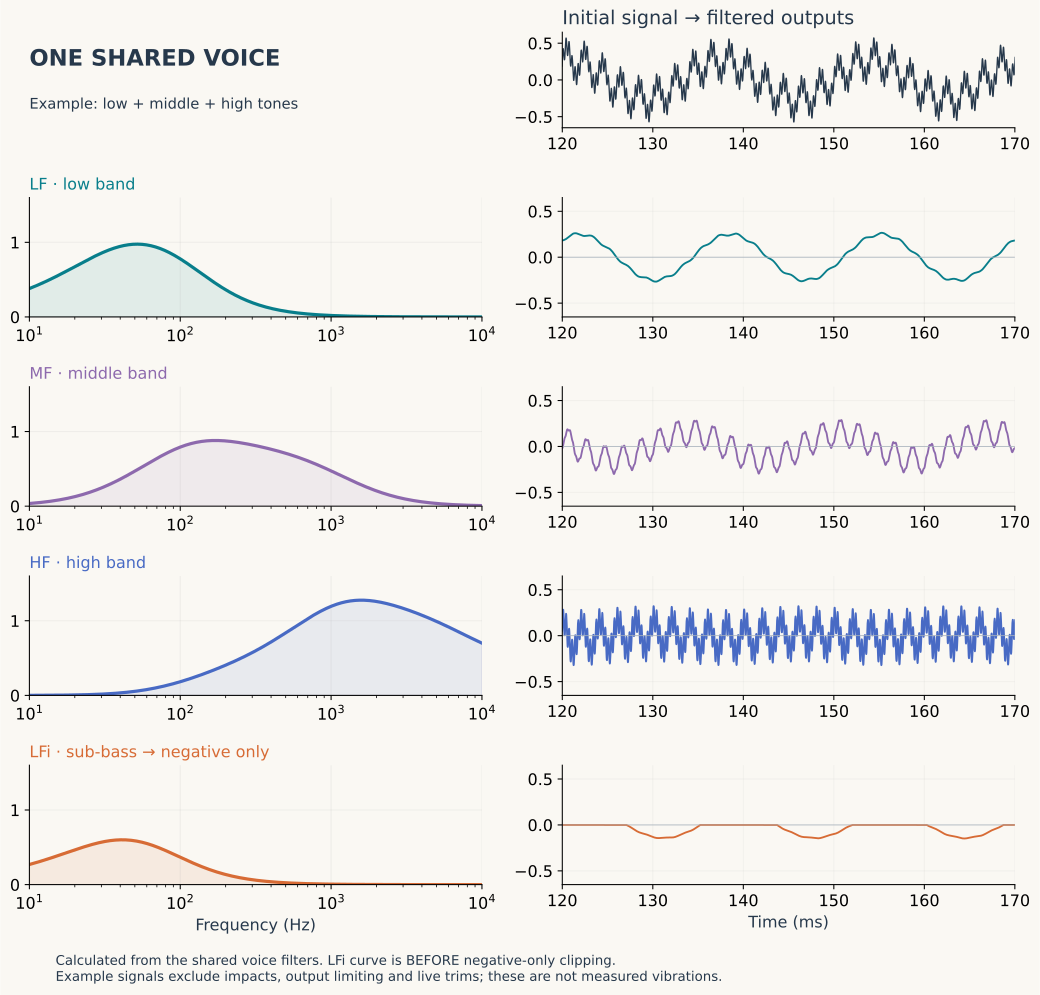

The recipes remain flexible. The rolling ball has its own routing. The moo bypasses this crossover, sending its voice directly to MF and HF and a quieter copy to LF, with a landing contact on LFi and LF.
The rolling ball is back, with its own surface
The ball now has a more distinctive feel: a repeating flutter as it rolls, fine detail when it creeps, and a hollow knock when it reaches the end of the tube.
Its new synthesis starts with a small, fixed signature of five irregular bumps per ball revolution. The pattern repeats with distance travelled, using the circumference of a 10 mm ball. As the virtual ball moves faster, that same pattern comes around faster. It is not a stream of fresh random noise.
A second fixed pattern represents the fine surface finish. It helps carry slow motion, when the larger bumps alone would produce very low-frequency variation, and fades out as speed increases. The surface excitation also drives a damped tube-body resonance. Wall contacts add two different ingredients: a low plastic thud and a short, bright tick.
From one ball to a rainstick
A rainstick asks for almost the opposite of a single rolling ball. Instead of following one object, the hand and ear need to receive a stream of many small contacts.
The current model simulates 72 grains moving through a finite two-dimensional tube section with staggered obstacles. They are a sample of the fill, not a claim that a real rainstick contains only 72 particles. Their collisions produce a contact density and energy that drive a much denser synthesized grain cloud.
Most contacts merge into the continuous sound and tactile patter. A few larger events remain separate knocks. The model is scaled to a roughly 20 cm handle; the pour has a beginning, a flow and an end, rather than wrapping particles around indefinitely.
A simplified animation of the idea: grains strike obstacles, scatter, and settle. Flip the tube to pour them back.
The sand, rice and beans settings provide different characters to explore. The fourth selection in that family is the moo box. Same handle, same tilt gesture, entirely different imaginary contents.
There is another practical wrinkle: the accelerometer also senses the actuators. The rain model smooths axial acceleration and ignores small values before using it as a shaking input. Otherwise, the object risks reacting to its own vibration as though someone were shaking it.
And of course, a lightsaber
At some point I was holding a cylindrical handle full of actuators, with motion sensing and sound. Of course it had to become a lightsaber.
I wanted a little of that first-film moment when Obi-Wan introduces Luke to a lightsaber: switch it on, hear the ignition, and suddenly this ordinary handle suggests something much more exciting. Then move it. The hum gives way to a swing, the sound follows the gesture, and a clash lands in the hand. This is a very enjoyable way to lose an evening to firmware tuning.
Recorded ignition, idle and swing sounds supply the voice. Overlapping excerpts keep the swing alive while motion continues; the gyroscope controls its response. The shared filters spread that voice across LF, MF and HF, while LFi adds negative-side bass and the physical clash. Sound and touch get to play the same scene together.
There is one decidedly uncinematic concern: the battery. All that humming and swinging has to come from somewhere. Still, my recorded lightsaber run on an 18650 cell lasted about 14.6 hours, with Wi-Fi logging enabled, before the sampled supply rail first fell below the chosen 3.3 V reference. That is one measured run, not fourteen hours of continuous duelling or a measurement to the battery’s protection cutoff. Enough time, at least, to get thoroughly distracted.
What reaches the handle?
The four-actuator sweep makes the reason for mixing visible: the mounted actuators do not respond alike. Here are simplified, smoothed trends from their individual measurements, plotted together from 0 to 1 kHz on a linear axis. The filter figure above uses a logarithmic axis from 10 Hz to 10 kHz.
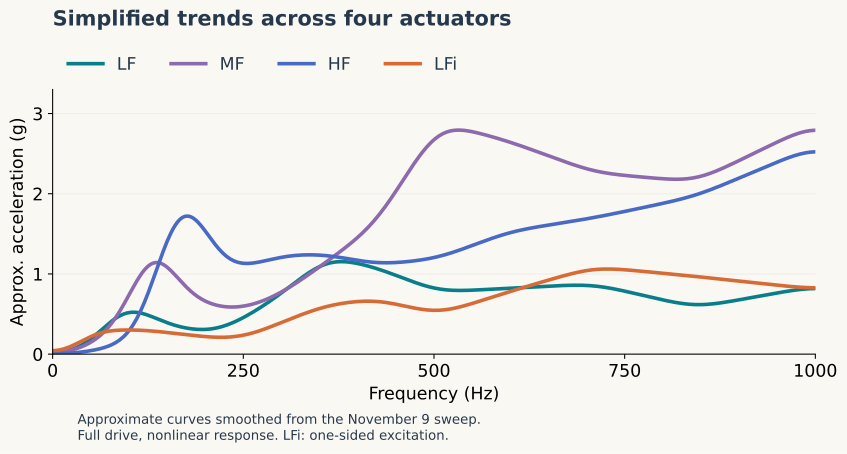
The filter plot explains how we shape the electrical signal. This plot shows the mechanical response at the sensor, over a smaller frequency range. Their amplitudes and axis scales are different; they are not curves to overlay. The difference between those two is where much of the experimentation lives, and why simply sending the same signal to every actuator is not the end of the story.
What makes a good moo?
The next comparisons can stay quite simple. Turn the handle slowly, then quickly. Reverse it halfway through a pour. Stop moving during a swing. Compare the sound with and without the contact at the end. Keep the gesture the same while changing the actuator balance.
For the moo, the question is whether the rising voice and final clunk belong to the same imagined moving weight. For the rainstick, it is whether a finite fill seems to travel through the handle. For the ball, it is whether the surface detail follows the motion rather than feeling like an unrelated vibration.
There is still measurement work to do on the current assembly and output settings. Reading the firmware tells us what signals it intends to produce; it does not replace recording the output or holding the device.
But the moo box is a useful destination precisely because the interaction is so simple. Turn it over. Something inside seems to move. It makes a sound, and lands.
A lot of electronics for a small cow. A rather good excuse to keep experimenting.
The project page collects the earlier builds. The public repository contains the project source.

Antoine Weill--Duflos
Head of Technology and Applications
My research interests include haptic, mechatronics, micro-robotic and hci.